B. 1903, White Plains, New York; D. 1983
Jeanne Reynal was a mosaicist whose revival of ancient techniques and experiments with abstraction mark a significant contribution to the New York School. Reynal was dedicated to challenging expectations of the medium by creating, as she described, “a new art of mosaic, a contemporary and fresh look for this ancient medium.” Her work was largely abstract and was shown at prominent venues for modern art like Betty Parsons Gallery in New York City.
Born in White Plains, NY, Reynal apprenticed from 1930-38 with Boris Anrep, a Russian mosaicist working in Paris. This established her interest in working with the medium. Reynal spent the World War II years living in San Francisco and in Sierra Nevada, California. Her first solo exhibition was held in Los Angeles in 1940.
Reynal’s father died in 1939, allowing her resources with which to build an art collection. She acquired a 1941 Jackson Pollock painting from Peggy Guggenheim’s gallery -- one of the first ever sales of a Pollock. At this time, Reynal developed a relationship with the first director of the San Francisco Museum of Modern Art: introducing her to the work of Pollock and other first-generation New York School artists, and helping to set the course of acquisitions and exhibitions at the museum. Reynal’s closest artist friend was Arshile Gorky, and his wife Agnes (known as Mougouch). Reynal would show her own work in the SFMoMA Annual exhibitions from 1940-46. During her West Coast years, Reynal also developed a friendship with Isamu Noguchi who had enrolled, voluntarily, in an internment camp to aid other Japanese-Americans. She would later collaborate with Noguchi on mosaics for tables of his design. Reynal was also associated with the Surrealists - many of whom were living in exile in the U.S. In 1945, Reynal took a six- week visit to the Hopi, Zuni, and Navajo Indians with André and Elissa Breton as interpreter and guide.
Reynal moved to New York City in 1946. At that time, she further developed friendships with artists including Willem and Elaine de Kooning. In 1955, she married Thomas Sills, a largely self-taught African-American painter. They traveled together across Russia, Turkey, Greece, and Italy in 1959 to further study the art of mosaic. In 1960, she was asked by Elaine de Kooning to take over the organization of a show of Abstract Expressionist women artists held that year in West Texas, at Dord Fitz Gallery. It was in this period that Reynal began exhibiting with Betty Parsons Gallery.
Jeanne Reynal
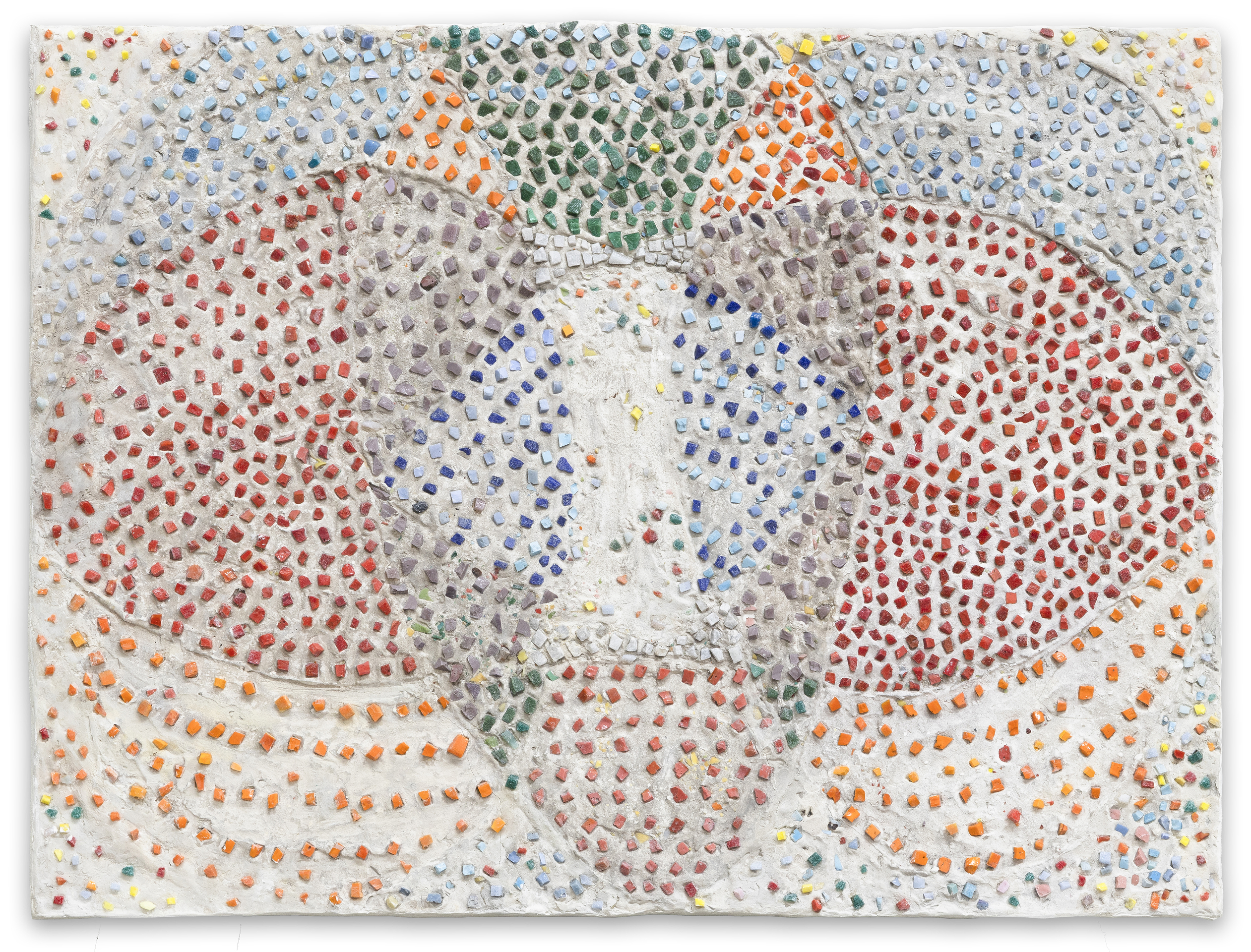
Untitled, 1950-52
smalti and pigmented cement on wood
58 1/8h x 48w inches
Reynal was the subject of a traveling solo exhibition in 1964, organized by the San Francisco Museum of Modern Art. The same year, a monograph of her work, with essays by Elaine de Kooning, Dore Ashton, and Lawrence Campbell, was published. The solo show traveled to the Sheldon Museum in Lincoln, Nebraska, a city where, the following year, Reynal would create mosaic murals for the State Capitol building.
Reynal traveled with her husband, Sills, throughout South and Central America: Mexico, Guatemala, Honduras, Peru. She was influenced by indigenous art throughout her travels. In the early 1970s, Reynal began making totem sculptures utilizing mosaic tesserae and pieces of shell. These monumental works were exhibited at Betty Parsons and at the Art Association in Newport, Rhode Island. In the late 1970s, she made a series of portraits in mosaic (many of artist-friends), and depictions of animals.
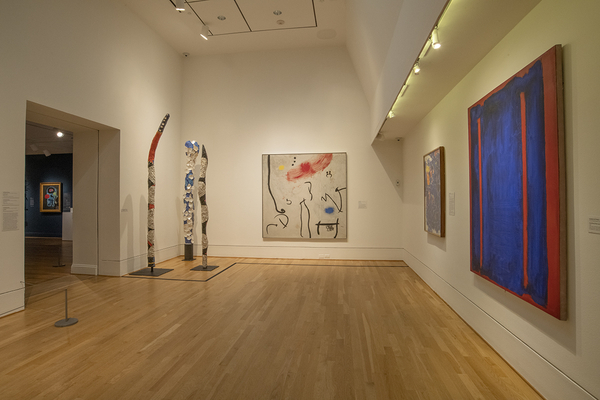
Eric Firestone Gallery represents the estate of Jeanne Reynal and presented a survey exhibition of her work, Mosaic is Light: Work by Jeanne Reynal,1940-1970, in 2021. Reynal’s work can be found in institutional collections throughout the country, including the Museum of Modern Art and the Whitney Museum of American Art, both New York; the Menil Collection, Houston; and the Los Angeles County Museum of Art. Her totemic works will be included in Miró and the United States, opening in 2025 at the Fundació Joan Miró in Barcelona, Spain, and traveling to the Phillips Collection, Washington DC in 2026.
Jeanne Reynal
Untitled, 1945
smalti and pigmented plaster on wood
18.0h x 24.0w x 1.0d in
45.72h x 60.96w x 1.91d cm
(JREY152)
Jeanne Reynal (1903-1993)
Untitled, 1958
smalti and pigmented cement on wood
29h x 22w in
73.66h x 55.88w cm
JREY001
Jeanne Reynal (1903-1993)
Untitled, 1960
72 3/4h x 36 3/4w x 1 1/4d in
184.79h x 93.35w x 3.18d cm
JREY005
Jeanne Reynal (1903-1993)
Winter Count, 1963
smalti, mother-of-pearl, obsidian and pigmented cement on wood
77h x 40 1/2w in
195.58h x 102.87w cm
JREY004
Jeanne Reynal (1903-1993)
Mother and Children Between Sun and Moon, 1966
smalti and Japanese shell on pigmented cement
48h x 60 3/4w x 2 1/8d in
121.92h x 154.31w x 5.40d cm
JREY058
Jeanne Reynal (1903-1993)
Amarillo, 1960
smalti and dyed Japanese shell on pigmented cement
72h x 60w in
182.88h x 152.40w cm
JREY041
Jeanne Reynal (1903-1993)
Songs of the Tewa, 1959
smalti and dyed Japanese shell on pigmented cement
82h x 81w x 2 1/2d in
208.28h x 205.74w x 6.35d cm
JREY099
Jeanne Reynal (1903-1993)
Rain Shadow, 1959
smalti, dyed Japanese shell and pigmented cement
66h x 56 1/4w x 3/4d in
167.64h x 142.88w x 1.91d cm
JREY122
Jeanne Reynal (1903-1993)
Untitled, 1965-67
smalti, mosaic tesserae, mother-of-pearl and pigmented cement on board
63 x 63 in.
160.02 x 160.02 cm.
Framed: 63h x 63w x 4d in
160.02h x 160.02w x 10.16d cm
JREY056
Jeanne Reynal (1903-1993)
The Round of Hours, 1964
smalti, Japanese shell, and poured glass on pigmented cement and steel
40h x 65 1/2w x 2d in
101.60h x 166.37w x 5.08d cm
JREY055
Jeanne Reynal (1903-1993)
Untitled, 1963
smalti, Japanese shell, hand-formed cement and steel
27h x 27w x 1 1/2d in
68.58h x 68.58w x 3.81d cm
JREY132
Jeanne Reynal (1903-1993)
Two Rivers, 1970
mosaic tesserae, mother-of-pearl, Japanese shell, concrete and steel
111h x 11w x 5 1/2d in
281.94h x 27.94w x 13.97d cm
JREY080
Co-organized with the Fundació Joan Miró in Barcelona, Miró and the United States explores the vibrant exchanges between Catalan artist Joan Miró (1893-1983) and the burgeoning American art scene in a pivotal moment of 20th-century art. Featuring 75 works by more than 30 artists, this exhibition reframes Miró’s legacy, revealing how his dream-like pictures evolved through artistic dialogue and experimentation with his American counterparts.
An intergenerational dialogue between Joan Miró and artists such as Louise Bourgeois, Helen Frankenthaler, Lee Krasner, Arshile Gorky, Alice Trumbull Mason, Jackson Pollock or Mark Rothko, among many others, showing how their creative practices mutually enriched and contributed to the development of 20th-century art.
The exhibition will include more than 130 works from American and European collections, as well as from the Fundació Joan Miró's own collection, both by Miró and by a range of artists from various generations.
The 6 artists in All The Things defy the conventions of traditional painting. They adeptly blur the boundaries between "support" and "surface," employing techniques such as manipulating stretcher bars, cutting canvas, and integrating diverse materials to construct their artworks rather than solely relying on paint. Drawing inspiration from elements of drawing, collage, and sculpture, these artists not only push the limits of painting but redefine its language.
Jeanne Reynal, A Good Circular God, 1948–50, is on view at the Museum of Modern Art in 2023.

In the days before smart phones and email, people hand wrote contact information in books designed for that purpose. Telephone numbers were prefixed by two-letter abbreviations for exchanges, such as Butterfield (BU), Chelsea (CH), Trafalgar (TR) and Plaza (PL). Three such books belonging to Jackson Pollock and Lee Krasner have survived: two are among their papers in the Smithsonian Institution’s Archives of American Art; one is owned by the Pollock-Krasner House and Study Center. All three books will be on view, together with some 30 works by artists whose names, addresses, and telephone numbers appear in them.
The Addison Gallery of American Art at the Phillips Academy, Andover, MA
Comprised almost entirely of works from the collection—including Jeanne Reynal's Servants of the Sun, 1950—this exhibition explores how women have deployed the visual language and universal formal concerns of abstraction—color, line, form, shape, contrast, pattern, and texture—to create works of art across a wide variety of media (including paintings, sculptures, drawings, photographs, ceramics, textiles) from the 18th century to the present day.
In the spring of 1963, the New York Art Committee for Tougaloo College established Mississippi’s first collection of modern art at Tougaloo, a historically Black college located north of Jackson. As civil rights protests swirled across the fiercely segregated state, the College became an unlikely hub of European and New York School modernism and a place that the collection’s founders envisioned as “an interracial oasis in which the fine arts are the focus and magnet.” Co-organized by the American Federation of Arts and Tougaloo College, Art and Activism traces the birth and development of this significant and distinctive collection. With approximately thirty-five artworks by artists such as Francis Picabia, Jacob Lawrence, and Alma Thomas, the exhibition brings renewed attention to a complex American collection established at the intersections of modern art and social justice.
Mostly New: Selections from the NYU Art Collection presents modern and contemporary artworks, the majority of which have entered the New York University Art Collection over the last decade.
The founding of the NYU Art Collection followed A. E. Gallatin’s Gallery (later, Museum) of Living Art, which operated from 1927 until 1942 in the same space the Grey currently occupies. As the first American institution to exhibit living artists, Gallatin’s Museum provided an important forum for contemporary visual expression and access to original works for NYU students. Initiated in 1958, the NYU Art Collection grew quickly through the mid-1960s, with many sculptures, drawings, prints, and photographs installed throughout the campus. In 1975 Abby Weed Grey donated some 700 works from the Middle East and Asia dating primarily from the 1960s—a magnanimous contribution that also established the Grey Art Gallery as NYU’s fine arts museum. The collection will again expand significantly with Dr. James Cottrell and Joseph Lovett’s promised gift of approximately 200 artworks—a number of which are on view here—by downtown New York artists.
Jeanne Reynal
ERIC FIRESTONE GALLERY | NEW YORK
In 1958, Clement Greenberg penned a short essay that posited aesthetic parallels between Byzantine art and modernism. Despite their differences, he said, these movements were united by an emphatic pictorialism, their transcendent qualities tied up with a shared repudiation of illusionism. In this text, the critic cited the work of certain painters, such as Barnett Newman, Jackson Pollock, and Mark Rothko, as examples. “This new kind of modernist picture,” Greenberg wrote, “like the Byzantine gold and glass mosaic, comes forward to fill the space between itself and the spectator with its radiance.”
During the acent of Abstract Expressionism, Reynal reinvented the art of msaics, embracing lyrical geometries and biomorphism in a glimmering, varied body of wall-mounted and freestanding works. This bountiful survey, filling two floors at Eric Firestone Gallery, spans three decades of the New York School artist's career, from 1940-1970. (Reynal died in 1983, at the age of eighty.) Her novel approach involved a degree of spontaneity that is not usually assocated with the ancient medium; a short documentary on view, from 1968 captures Reynal speedily sketching into wet cement and scattering stone tiles. Her early compositions are flat and graphic, as examplified ina 1943 collaboration with Isamu Noguchi, for which she decorated the surface of a low triangular table. But moody, encrusted works fromt he fifties play up the craggy topographical potential of mosaics, which Reynal studied with a Russian master, in Paris, in the ninteen-thirties. By 1970, her pieces had become quai-figrative, seen here in striking procession of undulating, patterned pillars rising from a bed of white gravel.
Raised in and around New York by French parents, Jeanne Reynal (1903–83) spent most of the 1930s apprenticed to a Russian mosaicist in Paris. She came back with strong opinions: Mosaic was neither painting nor sculpture, she wrote in a 1964 monograph, and Renaissance artists had “taken an ax” to the ancient art form by laying their tiles flush instead of letting them protrude to catch the light.
Policing genre boundaries no longer seems so important. But the strongest pieces in this show, titled “Mosaic Is Light: Work by Jeanne Reynal, 1940–1970,” derive much of their considerable impact from their disconcerting perch between painting and sculpture.
“Ogo,” a cement-on-board panel just over 4 feet by 5 feet, is a busy abstract whorl of reds, grays and blacks. As a painting, it would be overwrought. But the variety of its textures — the pits, the streaks, the unexpected glitters as you shift from foot to foot — draw your attention away from the composition and, in a way, counterbalance it. Three 1959 monochromes — a flat red hexagon, an enormous yellow diamond, and a triptych of blue squares, all of them strewn with broken glass and mother-of-pearl — go further, wringing so much action out of a broken surface that the very notion of a flat one comes to seem absurd.
Seven elegant monoliths that Reynal made in the early ’70s after a trip to Africa do something like the opposite. Covered with red, black and gold tiles so shiny they’re almost reflective, and studded, in one case, with palm-size pieces of mother-of-pearl, their surfaces dazzle, letting their sinuous shapes slip right behind your eyes.